Few museums in the world can boast a collection that covers everything – from a fragile aircraft built by aviation pioneers at the start of the 20th century to the wreckage of a stealth bomber shot down in a modern war. The Aeronautical Museum in Belgrade is exactly such a place: unassuming, somewhat forgotten, but absolutely unique.
|
Need an International Driving Permit for Serbia? You can apply for your International Driving Permit online before your trip. More information is available here: idaoffice.org |
Important note: At the time of writing this text (2026), the Aeronautical Museum is temporarily closed to visitors due to a major reconstruction. The Government of Serbia has announced a reopening in 2027. All information in this article about the exhibits, architecture, and history of the museum remains relevant and useful for planning a future visit.
Why this museum is special: its place in the world
There are only a handful of aviation museums in the world that can boast a collection of more than 200 aircraft. Belgrade is one of them – and not because of generous funding or a large market, but because of a very particular historical fate. After the Second World War, Yugoslavia was the only country that operated both Eastern and Western aircraft, received military aid from the United States, bought British engines, and at the same time developed its own aviation industry. That combination of circumstances created a collection you cannot see in London, Washington, or Moscow.
Experts who visited the museum over the decades regularly pointed out that the Belgrade collection belongs among the top ten or so institutions of its kind in the world – not because of the size of the building or its budget, but because of the variety and authenticity of its exhibits. Aircraft preserved here exist nowhere else: the only surviving Fiat G-50 fighter, original planes from the Balkan Wars, domestic designs flown in Yugoslav colors, and fragments of an American stealth bomber. All under one roof, on the edge of the airport runway.
The paradox of the museum is that for years it was barely known even among tourists in Belgrade. Travelers passing through the airport hardly noticed the strange round building next to the control tower. And inside, history was waiting – more than a century of flight, war, invention, and pride, packed into a space that does not look especially impressive from the outside, but takes your breath away inside.
The building: an architectural exhibit in its own right
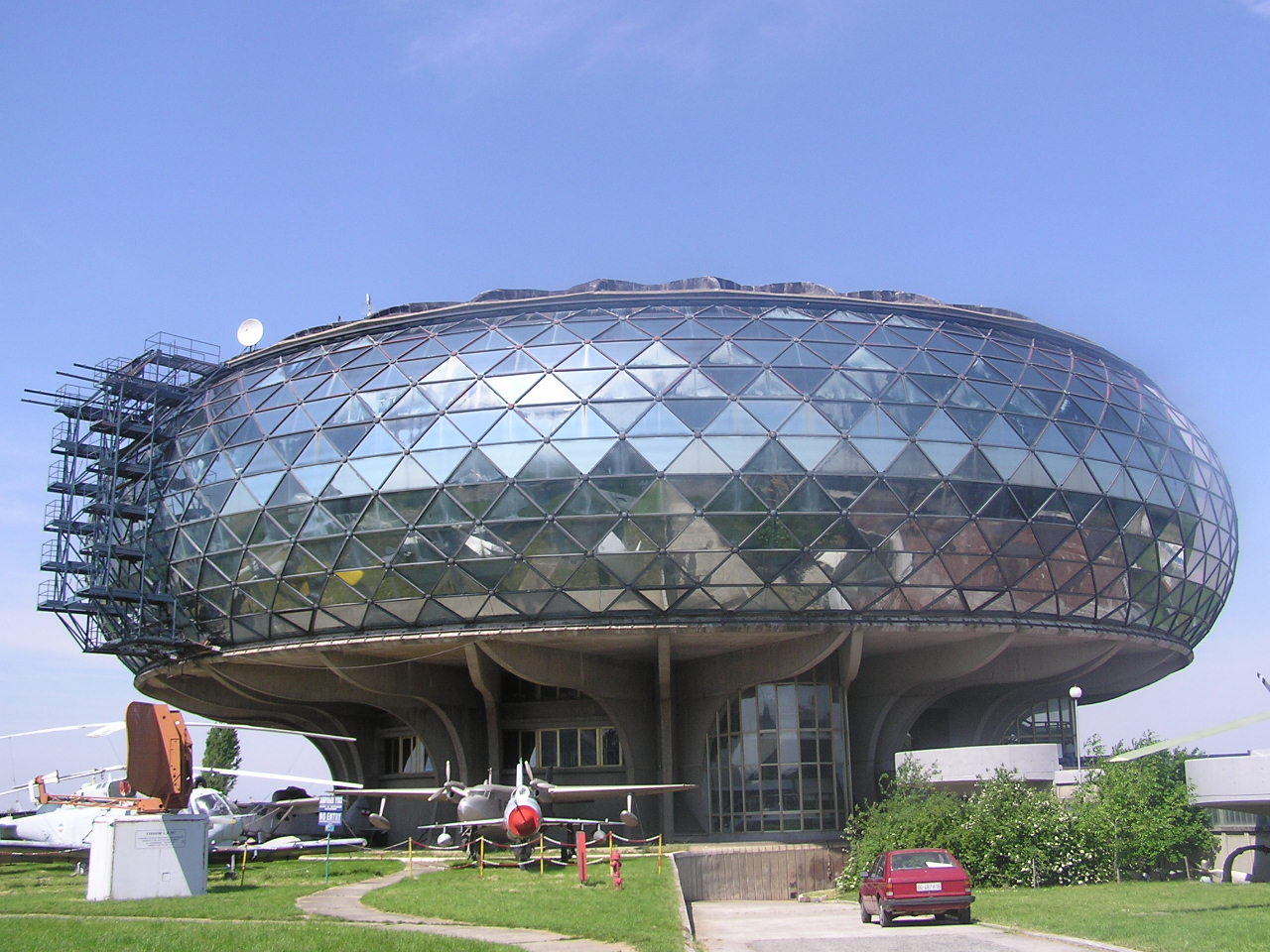
When they first see the museum, visitors often stop in confusion. In front of them rises a massive circular structure of glass and concrete, resembling some kind of space station or, as some have called it, an “alien mushroom.” There is no classical entrance, no symmetrical façade, no hint of what a museum is supposed to look like. As it turns out, that was exactly the point.
The building was designed by Sarajevo architect Ivan Štraus, who won the 1969 competition with a concept that still feels avant-garde today. The basic idea was for the building itself to be part of the exhibition – for the outer glass ring, shaped like a torus, to allow the exhibits to be viewed in their natural setting: the sky. Aircraft suspended from the ceiling of the interior gallery seemed to float toward the glass, beyond which stretched the flat airport landscape. For its time, it was a revolutionary museum concept.
Construction lasted nearly twenty years – from 1969 to 1989. Technical and financial problems extended the deadlines, but the final result was worth the wait. The structure of nearly 10,700 square meters was divided into exhibition space, storage, workshops, and administrative areas. The floor, mezzanine, gallery, and basement were organized so that every visitor naturally passed through all periods of aviation history. In 2013, the Government of Serbia declared the building a cultural monument – a rare kind of paradox: a museum whose shell is itself protected as cultural heritage.
Around the building, on the open plateau surrounding the entire complex, aircraft, helicopters, radars, and missiles that could not fit inside were displayed. The plateau functioned as an extension of the exhibition in the open air, although the condition of those exhibits became increasingly worrying over the years – a JAT Caravelle, old military aircraft, and a radar antenna stood exposed to rain and sun without adequate protection. The reconstruction that is beginning is expected to solve that problem as well through the construction of enclosed hangars.
A brief history: from the first exhibition in 1925 to today
The idea of preserving aviation artifacts in Serbia is not new – it goes back to 1925, when the first aviation exhibition was organized in Belgrade. It featured the Blériot XI monoplane, captured at the airfield in Mostar in 1918 – an aircraft that symbolized the end of one era of war. The same airplane also appeared at the First International Exhibition in Belgrade in 1938, in the Yugoslav aviation pavilion.
The museum was officially founded in 1957 under the Air Force Command, then under the name Museum of Yugoslav Aeronautics. For years it operated in modest conditions – first in the Command building in Zemun, then in the Officers’ Club at the Old Airport. The collection grew, but the space did not. A solution was sought for decades, and it was finally found in 1969 – in the form of an ambitious architectural project on land next to what was then still the fairly modest “Belgrade” airport.
The opening of the modern building in 1989 was greeted with enthusiasm. The museum immediately became one of the most visited institutions in the country, attracting tens of thousands of visitors a year – children on school trips, aviation enthusiasts from abroad, and military professionals. During the 1990s, despite wars and sanctions, the museum continued to operate. The 1999 NATO bombing, paradoxically, also brought new exhibits.
Over the following decades, the museum gradually lost its shine. Without significant investment since the day it opened, the roof began to leak, the outdoor exhibits deteriorated, and the number of expert staff declined. A few years ago, the decision was made to close it temporarily to the public. The reconstruction announced for 2027 is supposed to bring new exhibition content using digital technology and artificial intelligence – in partnership with the British company Cultural Innovations and Serbian architects.
The collection: what the museum contains
The numbers speak for themselves: more than 200 aircraft, 130 aircraft engines, several radar and missile systems, a wide range of aviation equipment, more than 20,000 books and technical documents, and an almost unbelievable 200,000 photographs in the archive. But behind those figures are stories more valuable than any statistics.
Pioneers: aircraft from the beginning of the century
At the very entrance to the exhibition floor, visitors were greeted by an aircraft that looked as if it had fallen straight out of the sky from 1910 – because in a certain sense, it had. A replica of the Sarić 1 aircraft, created by Ivan Sarić from Subotica, held a place of honor in the museum display. In 1910, Sarić made the first flight in the history of Serbian aviation, in an aircraft of his own design. The replica was built with careful attention to the original plans, and in the museum space it looks almost surreal – a fragile wooden and fabric construction surrounded by metal monsters from later decades.
There is also the Oluj 11 – the first armed aircraft used by the Serbian army, an exhibit that directly connects the museum space with the Balkan Wars of the early 20th century. The Fizir FN, the first airplane produced in Serbia at the Ikarus factory, completes this pioneering section.
Second World War: both East and West
This is where what makes the museum truly exceptional begins. During the war, Yugoslav Partisans and the royal army used aircraft of different origins, and postwar Yugoslavia – unlike the other communist countries – maintained ties with both the West and the East. The result of that geopolitical peculiarity is visible in the exhibition halls: the British Hawker Hurricane and Supermarine Spitfire stand side by side with the Russian Yakovlev Yak-3 and Ilyushin Il-2 Shturmovik. The American Republic P-47 Thunderbolt meets the German Messerschmitt Me 109 G-2, which at one stage of the war flew in Yugoslav colors.
For aviation historians, this collection is a true treasure trove – many of these aircraft once faced one another in the air as enemies, and here they stand peacefully side by side, each with its own plaque and history.
Yugoslav aviation industry: a rarely mentioned source of pride
Few people outside Serbia know that Yugoslavia had its own serious aviation industry. The museum demonstrates this without pathos, through plain facts: the Aero-2 training aircraft, the intermediate 213 and 522 models, the C-49 fighter, the Utva 65 agricultural aircraft, and the experimental planes of Colonel Bešlin are all here. A special place belongs to the G-2 Galeb – the first Yugoslav jet-powered aircraft to be mass-produced. The Galeb was exported to several friendly countries and won an award at the Le Bourget Air Show in Paris as the best aircraft in its class. That is no small thing – it is global recognition.
Fiat G-50: the only one in the world
Among the exhibits in storage awaiting restoration, one stands out in particular: the Italian-built Fiat G-50 fighter. It is the only preserved example of this aircraft on the planet. Museums in Italy do not have it. Collectors around the world do not have it. It exists only in Belgrade, in a condition that requires careful restoration. When that restoration is completed, Belgrade will have an exhibit that is literally unique in the world.
F-117 Nighthawk: wreckage that changed military doctrine
Perhaps the most provocative exhibit in the museum’s collection is the one that did not fly – or rather, the one that could no longer fly. During the 1999 NATO bombing of Yugoslavia, Serbian air defense shot down an American F-117 Nighthawk, known as the “stealth bomber.” It was the first and, to this day, only recorded case in which this aircraft was brought down in combat conditions.
Fragments of that aircraft – and parts of a downed F-16 Fighting Falcon – were collected and displayed in the museum. The exhibit attracted enormous interest not only from the public but also from military analysts and engineers. Many military experts and journalists came to Belgrade specifically to see it. The story of the F-117 shootdown became the subject of studies at military academies around the world, and the museum remains the keeper of the physical evidence of that episode.
Reconstruction and the future of the museum
The Aeronautical Museum is going through the most important period in its history since 1989. Closed a few years ago because of the deteriorated condition of the building – the roof was leaking, equipment was decaying, and the conditions for preserving the exhibits were far below standard – the museum has finally received the institutional attention it has long deserved.
The Government of Serbia transferred management of the museum from the Ministry of Defense to Aerodrom Nikola Tesla a.d., which launched an ambitious reconstruction project. The British company Cultural Innovations, specialized in creating museum experiences across Europe, the Middle East, and America, is responsible for developing the new exhibition concept. In cooperation with architects from A3 architects, a master plan was developed that does not alter the visual identity of Štraus’s building, but drastically improves the interior space.
The construction of new multipurpose hangars is planned, which will finally provide a home for dozens of aircraft that stood outdoors for years exposed to the elements. Digitalization and artificial intelligence will be integrated into the visit – each visitor will be able to receive a personalized experience based on their own interests, from technical details to historical stories.
The target opening date is 2027, which coincides with Expo 2027 hosted by Belgrade. If everything goes according to plan, the museum that stood closed for years will reappear before the world in a completely new form – but with the same priceless exhibits.
Practical information for visiting (after reopening)
Here is what you should know for visiting the museum as soon as it reopens – and by all indications, that should happen in 2027. Information about opening hours and ticket prices should be checked on the museum’s official website muzejvazduhoplovstva.mod.gov.rs or by direct contact at muzej.vazduhoplovstva@mod.gov.rs, as the conditions will likely change after the reconstruction.
| Category | Before reconstruction (reference) | Note |
|---|---|---|
| Foreign nationals | 500 RSD (~4 EUR) | Check after reopening |
| Citizens of Serbia | 290 RSD | Check after reopening |
| School-age children | 250 RSD | Check after reopening |
| Opening hours (summer) | Tue-Sun, 09-18:30 | Check after reopening |
| Opening hours (winter) | Tue-Sun, 09-16:00 | Check after reopening |
| Parking | Free | Right next to the museum |
How to get there
The museum is located right next to Nikola Tesla Airport, around 200 meters from the terminal entrance – it is visible from the road leading to the airport. From the airport, the museum can be reached on foot in five to ten minutes, which makes it ideal for a traveler with a free hour between flights.
From central Belgrade, the easiest way to get there is by taxi or the Bolt app – the ride takes about 25 to 35 minutes depending on traffic. The A1 bus running between the airport and Republic Square passes very close by, but the pedestrian approach to the museum is not ideal, so a vehicle is recommended for anyone who does not have much time.
For group and school visits, the museum previously organized guided tours with experts – which was one of its truly valuable offerings, because the guides knew the stories behind every exhibit in a way that cannot be read on any information panel.
Is the museum worth visiting? Our assessment
Before closing, the museum had one unusual quality: it left different impressions on different people. For children and aviation lovers, it was a dream – a room full of real aircraft, hanging from the ceiling or standing just a meter away, without glass barriers or protective railings. For occasional tourists, it sometimes felt tiring and disorganized, without enough context in English. For military historians, it was one of the key places in Europe.
The reconstruction should balance those experiences. If the new exhibition manages to tell the stories behind the exhibits well – and not merely increase the number of screens and lighting effects – the museum could become one of the truly unmissable destinations in the Balkans. Because the foundation is extraordinary. It is hard to imagine a better introduction to the history of the 20th century through the lens of aviation than walking among the aircraft displayed here, from Ivan Sarić’s fragile construction to the wreckage of the F-117.
Our advice: Follow the museum’s official website and official social media account for news about the reopening date. A weekday morning visit, when crowds are smaller, is still the best recommendation – aircraft deserve a calm conversation, not standing in line.